Thursday, 29 December 2016

Neville Brody

Neville Brody is an English graphic designer, typographer and art directer.
He is known for his work on The Face magazine (1981–1986), Arena magazine (1987–1990), as well as for designing record covers for artists such as Cabaret Voltaire, The Bongos, and Depeche Mode.

Brody's experimentation with his self-made sans-serif typography, along with his Pop Art and Dadaism influence, caught the attention of music record companies such as Fetish Records and Stiff records after he left college. His CD covers leads toward a grudgy and a punk scene. The album Micro-Phonies by Cabaret Voltaire was art directed by graphic design heavyweight Neville Brody in 1984. Brody's infamous typography features on the front and a bandaged figure spouting liquid from the mouth stares blankly at the viewer. Brody made his name largely popular through his revolutionary when he worked as an art director for "The Face" Magazine. He changed up the "basic" and "structural" rules that existed in the British culture into a more artsy and vibrant aesthetic. His designs provoked some form of emotion to the extent that people would stick to one page instead of turning pages like they would normally do when reading a novel.

Image result for neville brody work
Personal view on his work...
Positives
- use of colour, vibrancy 
- not all squashed up
Negatives
- lots of white/ plain spaces on some pictures

David Carson

David Carson is an American graphic designer. Best known for his innovative magazine design and use of experimental typograpghy.
He was the art director for the magazine Ray Gun, in which he employed much of the typographic and layout style for which he is known. In particular, his widely imitated aesthetic defined the so-called "grunge typography" era.

In 1995, Carson left Ray Gun to found his own studio, David Carson Design, in New York City. He started to attract major clients from all over the United States. During the next three years (1995–1998), Carson was doing work for Pepsi Cola, Ray Ban, Nike, Microsoft, Budweiser, Giorgio Armani, NBC, American Airlines and Levi Strauss Jeans, and later worked for a variety of new clients, including AT&T Corporation, British Airways, Kodak, Lycra, Packard Bell, Sony, Suzuki, Toyota, Warner Bros., CNN, Cuervo Gold, Johnson AIDS Foundation, MTV Global, Prince, Lotus Software, Fox TV, Nissan, quiksilver, Intel, Mercedes-Benz, MGM Studios and Nine Inch Nails.

Image result for david carson ray gunImage result for david carson graphic designer
Personal view on his work...
Positives
- use of colour
- use of layering 
Negatives
- too much going on in one picture, very squashed

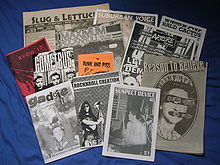
Zines

Definition - a magazine, especially a fanzine.
A zine is most commonly a small circulation self published work of original or appropriated texts and images, usully reproduced via photocopier.

Zines are self- published, small circulation, often non profit books, papers or magazines. The usually deal with topics too controversial or niche for mainstream media, presented in an unpolished layout and unusual design.
We created zines last year using just 1 sheet of A3 paper and would fold it in certain ways to then  create a little booklet. This year I made it using a different method, I created 8 different collages on 8 A4 peices of paper and then they were then photocopied smaller.
Image result for zines layoutsImage result for zines